
Welcome to this update from New World Same Humans, a newsletter on trends, technology, and society by David Mattin.
If you’re reading this and haven’t yet subscribed, join 30,000+ curious souls on a journey to build a better future 🚀🔮
It has been commencement address season in the United States. That means successful people have been invited to stand in front of young graduates — those about to leave university and make their way in the world — to offer them the kind folksy life advice that Americans do so well.
This year, a startling pattern has emerged. At the University of Central Florida, a real-estate executive described AI as the next Industrial Revolution. He was booed. At Middle Tennessee State University, a speaker mentioned AI and drew many boos. And then, last week, Eric Schmidt — CEO of Google for a decade — took to the stage at the University of Arizona to address several thousand graduates.
Schmidt began with a history of the personal computer. Then he turned to AI. When he told the crowd that machine intelligence will touch every classroom, profession, and laboratory, the audience erupted into boos. He tried to recover. ‘I know what many of you are feeling about that,’ he said. ‘I can hear you.’ He acknowledged a fear among the young generation that AI was about to eat their future, and especially their chance of meaningful (or perhaps any) work. He said he understood those fears, but urged optimism. When someone offers you a seat on the rocketship, he said, you do not ask which seat. You just get on.
The booing, I’m afraid, only intensified.
For what it’s worth, these recent scenes align with the conversations I’m having with friends who have college-age children. Many of those young people, I’m told, see AI as a socially corrosive force. What’s more, they view its outputs as cringe, and look with embarrassment at the way their elders enthuse over AI-generated text or images.
Meanwhile, when my Full Moon colleague Mark Curtis and I spoke to young people about AI recently, we heard fears that intelligent machines will suck meaning, and the chance for community and creativity, out of the workplace.
Taken together, all this is a signal. A monumental anti-AI movement is taking shape, and young people are at its heart. It’s worth noting that this is an inversion of the generational dynamic we usually see around new technology. We expect the young embrace the new, while older people remain sceptical or outright hostile. Here, we see the reverse. A generation of young people, now at the foothills of their adult lives, are refusing the story being told to them by the powerful: that AI is an unstoppable force, that it will reshape everything, and that their only option is to comply. To get on the rocketship.
This growing anti-AI sentiment is one fragment of a far broader phenomenon. One I’ve been writing about for years now, including in these postcards. That is, the emergence of two great ideological coalitions, which I call the coalition of creatures and that of machines.
The creatures embrace embodiment, limits, and the human-scale. They believe that our mortality and rootedness in the physical world are not problems to be solved, but the foundation of everything that matters. The machines, meanwhile, quest after the technological transcendence of all limits, including the limits of the human person itself itself. They want to merge with the machines, fly off into the stars, and embrace infinity. They see biology as a constraint to be overcome; the only challenge is to build the tools that will allow them to do so.
Both coalitions are taking shape around us now. So much of the weirdness we’re living through — including the strange intersection of Silicon Valley overlords and the Trump administration — is a product of this reordering. It is the sound, in other words, of a civilisation reordering itself around the creature and machine worldviews. A monumental clash between those worldviews is coming. It will reshape our economies and societies; it will reach into our families. And our politics, too: the elections of the coming decades, including US presidential elections, will increasingly be contested along creature-machine lines.
As regular NWSH readers will know, I’m in the middle of writing a book about all this.
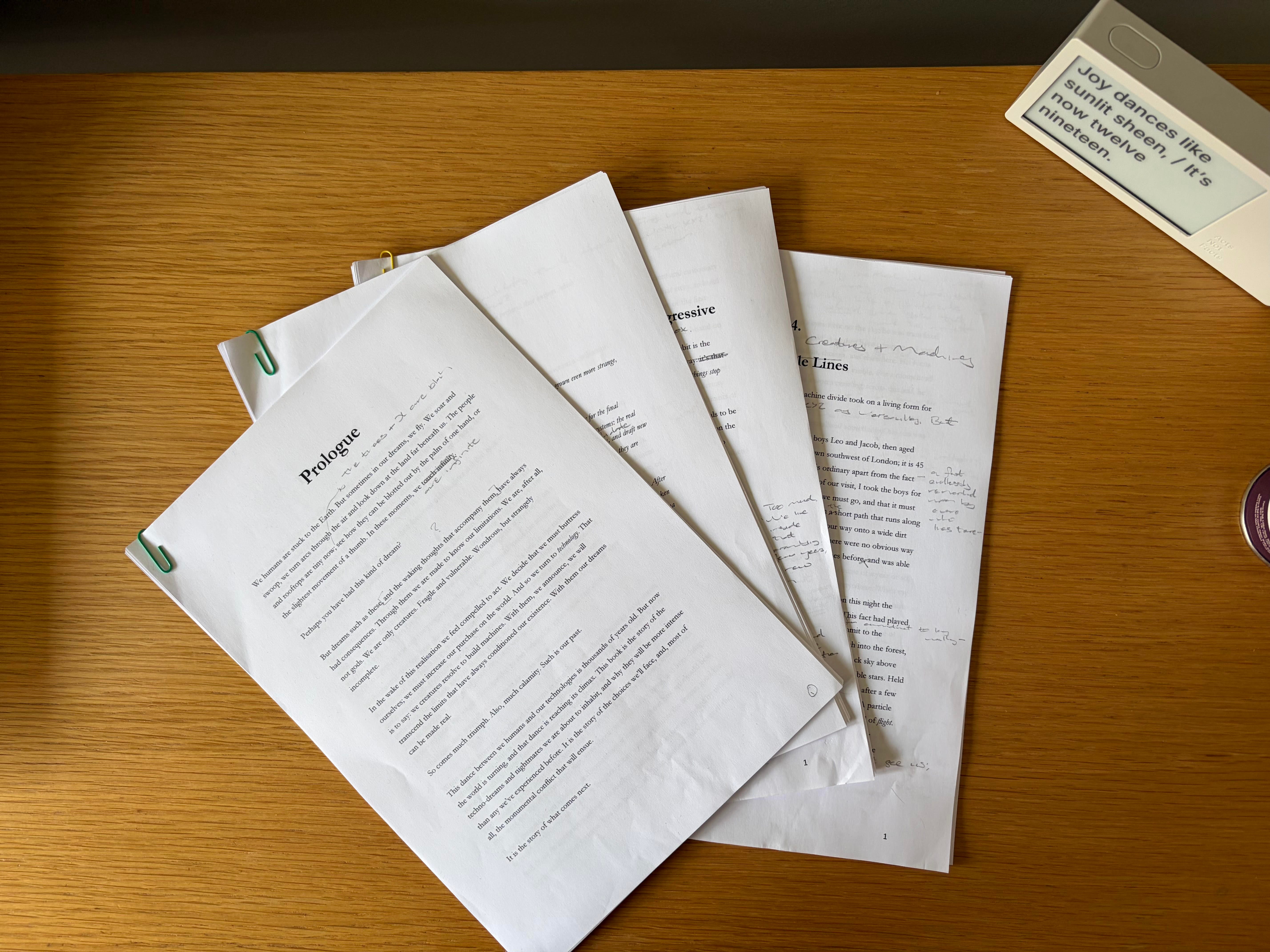
Creature vs Machine is my first book, and part of the challenge I’m facing is keeping pace with a story — and a broader technology landscape — that is evolving around me at lightspeed as I write. These commencement speech incidents will now find a home in my narrative, and I’m sure there will be much more ahead that I’ll need to weave in. More broadly, accelerated change will be a huge challenge for non-fiction publishing from now on, and especially non-fiction that has anything to do with technology. By tradition, the publishing world is slow. Even once you’ve finished the book, it often takes a year before it’s published and sitting on bookshelves. In tech, a year is an awfully long time. Writers, and the industry, are going to have to speed up.
If all goes to plan, Creature vs Machine will be published in late 2027, by Bodley Head in the UK and Crown in the US. As for the AI backlash, we’re just at the beginning.
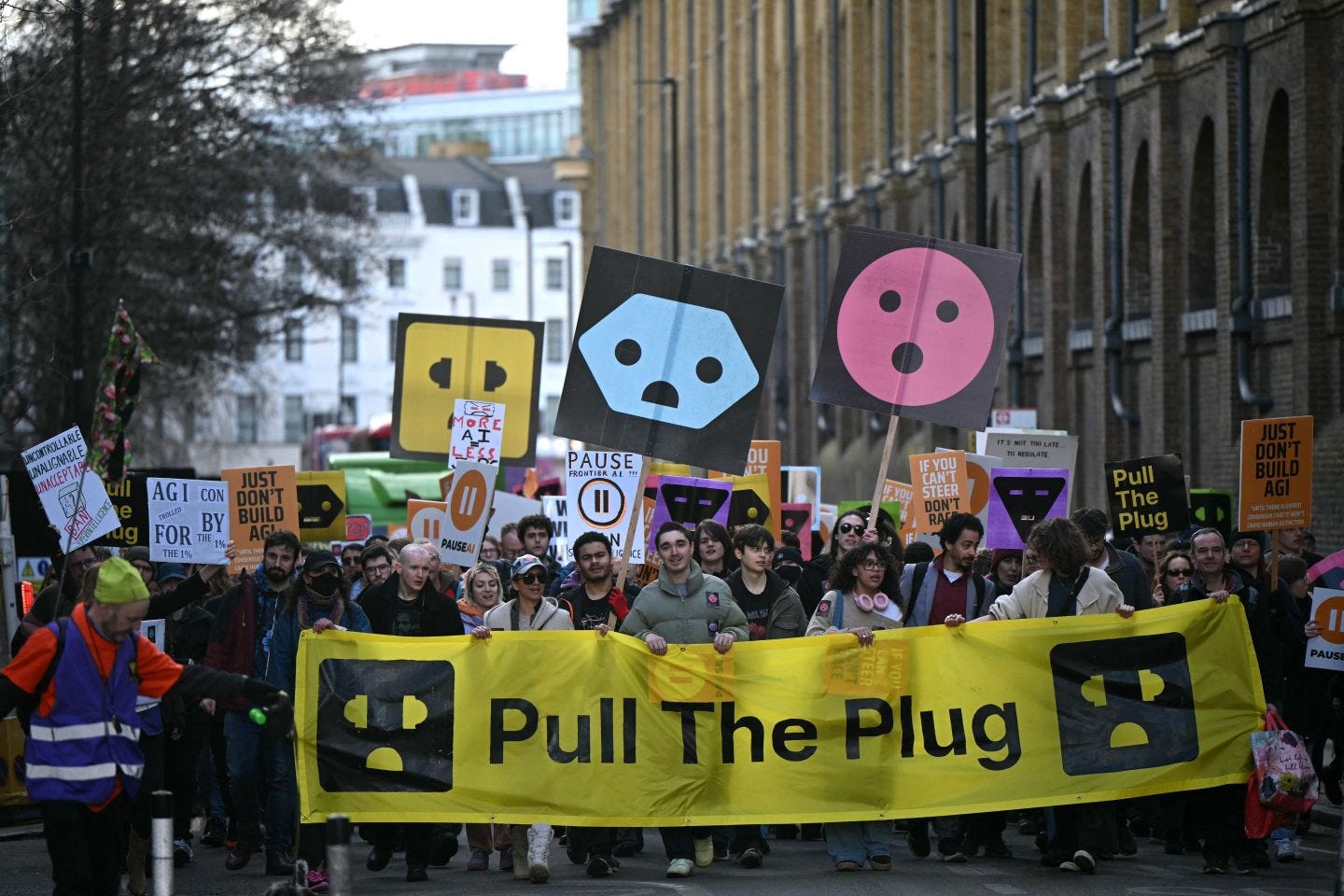
In Utah this month, hundreds of people gathered to protest the construction of the planned Stratos AI data centre, which at 40,000 acres will span an area more than twice the size of Manhattan. The facility will consume around 9GW of power; more than currently used by the entire state of Utah. In February, an activist group called PauseAI led more than three hundred people through London’s King’s Cross — home to offices of OpenAI, Meta, and Google DeepMind — to demand that AI companies pause the development of frontier systems. These are creature impulses, even if the people involved do not yet use that word. They are expressions of a deep conviction that something precious is under threat. And that the meaningful response is not unquestioningly to get on the rocketship, but to ask who is flying it, where it’s going, and whether that destination is really a place we want to go.
Much more is ahead. Things are going to get intensely weird. For now, I’m going back to the book writing.
See you next week,
David.
This was #29 in the series Postcards from the New World, from NWSH.
As they say, turkeys don’t vote for Christmas. Young people are at the sharp end of AI-driven job losses, hence the backlash. But I’m pretty sure they will also see the benefits in the medium term.
Either way, I don’t see them being able to stop the rocket ship.
(Got to say, putting a data centre in one of the driest states in the US is particularly mad though)
Spot on David. I always look forward to your onsite into our futures, at whatever age we may be.