

Welcome to this special update from New World Same Humans, a newsletter on trends, technology, and society by David Mattin.
If you’re reading this and haven’t yet subscribed, join 30,000+ curious souls on a journey to build a better future 🚀🔮
Hi Everyone,
It’s been a little quiet around here recently, but that’s all about to change.
And to get us started, here’s an essay of mine that I think will be right up your street. This essay was published in The Exponentialist, the technology-focused research service I founded with Raoul Pal. It went to those readers a while back, and it really struck a chord; it’s still one of the essays I get asked about most often. The ideas in it remain deeply relevant as 2026 gets underway.
This piece is called What Do I Tell My Children? It’s about navigating the wildly new future that intelligent machines are building around us.
Enjoy!
Introduction
My working life consists of lots of research and a ton of writing. That’s the part you see here in The Exponentialist.
But in addition to that, for years now I’ve done a lot of public speaking. The year just passed was no different. Among others, I went to speak to the C-suite of a UK-based challenger bank. To the C-suite of a high street health and wellness retailer. And to the marketing team at a global media network.
And they all had one request: talk to us about AI.
That was no surprise; it’s been this way for the last three years or so, ever since the ChatGPT moment. Every business is struggling with the same questions: what does AI mean for us? How can our people put it to work? How will it change our customers?
These are the questions I address when I speak.
But at the end of these talks the same thing happens; almost infallibly. I take some questions, and then there’s a pause. Amid the silence, someone will tentatively raise their hand, as though they are unsure whether they’re allowed to do what they are doing. And then they’ll say something like this:
‘That was all very interesting. But having listened to your vision of what is coming, I’m deeply worried.
I’m the parent of an eight-year-old girl and an eleven-year-old boy. My head is spinning on what this world is going to mean for them. If AI is going to be as powerful as you say, if it’s going to do so much of the work currently done by humans, if AIs are going to start businesses, and discover new scientific theories, and run financial markets, what role does this leave for my children? What kind of career are they going to pursue? What kind of life can they build? What am I supposed to tell them?’
Across the last 20 talks I’ve given, I’ve got some version of this question almost every time.
That’s totally understandable. I know firsthand: once you have an inkling of the vast changes that are coming, then as a parent it’s impossible not to have deep concerns.
And, of course, you don’t have to be a parent to be worried about these issues. The AI revolution is unfolding at lightspeed; if you plan to be alive ten years from now, then it’s going to have a profound effect on your working life, too. You’ll be asking: where is all this going? How will it affect me? What can I do to prepare?
Many of us are old enough to remember — just about — a form of working life and attendant social conditions that have now passed into history. I mean the form of life that is latent in a picture such as this:

We all know what a picture such as this signifies.
That is, the age of the prosperous middle class existence built on one ordinary salary. The corporate job for life; one in which ageing middle managers were not booted out as soon as they stopped being productive, but instead eased respectfully towards retirement in their early 60s. A retirement, by the way, funded by a generous pension that would allow them to maintain their standard of living.
That world, as we all know, is already long gone.
But what fewer people understand is that change is coming that will make that transformation look small indeed. Pretty soon, the working lives and attendant social conditions that exist now will seem as archaic as those in the picture above. And that will be just the start.
Nevertheless, I am fundamentally optimistic about what is coming.
We humans are fantastically adaptable. Each of us is a wellspring of infinite, insatiable wanting. And there are many things we’ll always want from each other. These three truths will form the basis of a new kind of economy. Yes, it will be an economy that is changed beyond all recognition — one we’d barely recognise as an economy now. But even in that new world, there will be many ways for humans to create and exchange value with one another.
So there will still be opportunities for your children — and your future self — to carve out a meaningful working life, and to build a wider life of joy and purpose. It will just all look much different to the typical careers, and routes through life, that we’ve lived through across the last 30 years or so.
In this essay, I want to go deeper on how I see all this playing out.
So this is my first properly codified, longform answer to the question I’m asked most often by the senior professionals I speak to: what do I tell my children? Remember if you have no children, the principles I’m about to lay out will still be deeply useful to you. Either for when you do become a parent, or as you plan the next five, ten, or 20 years of your life.
I’ve cultivated seven core principles to help prepare children for the coming Exponential Age.
But before I dive into them, I want to take a minute to define the challenge those principles address. That is, to define the set of conditions that I believe is coming.
The Coming Economic Singularity
We’re talking, in this essay, about how to prepare our children for what lies ahead with AI. So before we get into how to do that, we need to be sure we have some shared sense of a prior question: what, exactly, lies ahead?
After many essays, we’re all steeped in Exponential Age thinking. So I’ll keep this brief — a reminder of the AI-fuelled world that I have been writing about here for two years and more.
One glimpse of the world that is coming? Look at the results people are achieving with Claude Code. Look back, even, to OpenAI’s o3 model, released in December 2024. It can solve problems included in the Frontier Math Benchmark, a test designed to test AI models against the bleeding edge of mathematics. These are problems so hard that no ordinary person can come close to understanding them, let alone offering a solution.
In short, it seems likely now that we’re at the foothills of superintelligence — and something we can meaningfully call AGI — within the next five years. Perhaps far sooner.
What does that world look like? For our purposes, three major pieces of the puzzle are relevant:
AI is capable of performing 99% of the cognitive and knowledge work currently performed by people. We have near-infinite, superhuman knowledge workers.
AI is at the intellectual frontier. It is making new discoveries in science, maths, engineering, and tech, and transforming our view of the world around us. But we are struggling to understand much of what AI is uncovering.
AI can converse like a person (this has pretty much happened already) and autonomously perform complex and longrange tasks. Billions of people run their lives through an AI virtual companion that knows all about their tastes, preferences, and lifestyle.
I’ve written about a coming Economic Singularity. These three realities will form a key part of it. They will fuel change so vast it is hard for us, now, to envision what lies on the other side.
AIs will build startups in a day, launch tokens, take profits, and disappear. AIs will transact with other AIs. Big corporations — Accenture, Unilever, Disney and the like — will have vastly reduced need for human knowledge workers and creative talent. It goes on and on.
At some point — and this could happen quite suddenly — we’ll wake into a world in which all the old models and frameworks we’ve to make sense of the economy simply no longer function. We won’t exist in anything we currently recognise as an economy.
This famous image from Wait But Why captures something of the essence of what we’re talking about:
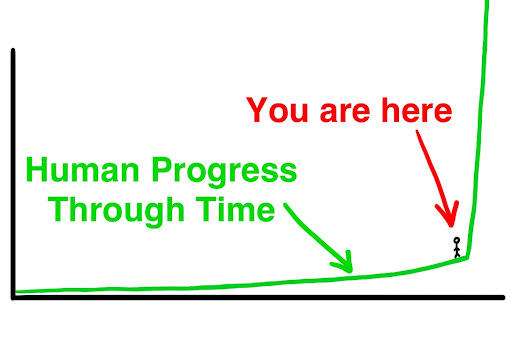
This is the vision that so worries the professionals I speak to.
It is a vision of a world utterly changed — in all kinds of ways. But when these professionals raise their hand and ask about the implications of all this for their children, it’s the career and economic implications specifically that they are asking about. The seven principles I’m about to lay out, then, focus on that. But everything, of course, impacts everything else, so via my seven principles I’ll also touch on broader social and personal implications of what lies ahead.
Okay, we’ve laid sufficient groundwork. Let’s get into it.
Designs for Life
Yes, vast change is coming. But amid it all, we can still help to prepare our children and our future selves.
Put these principles into action, and I believe you’ll build skills, behaviours, and attitudes that will empower your child to flourish in the new world that is coming.
The principles, of course, cannot be foolproof or comprehensive. They are my best early attempts to address a challenge that is in its early days, and evolving fast. I try to apply them as best I can as I raise my own children — twin 11-year-old boys — here in the UK.
I’ll lay out the principles one by one, and along the way we’ll develop a picture of the world I believe is coming.
Given the people I speak to and the nature of our economy, these principles are weighted somewhat towards parents who imagine a knowledge work future for their children. Many argue that in a world of AI, manual tasks — think gardening, or plumbing, or physical therapies — will skyrocket in value. There may be some truth in that in the short term. But given the pace at which humanoid robots are advancing it seems to me that the future of gardeners is also not clear.
So I’ve tried to develop principles that can provide a foundation to build on, whichever direction your child takes in the end.
1. Build your child a surfboard
This one is simple, but deserves some space.
At the deepest level, the challenges our children will deal with as they hit the labour market are twofold. They are lightspeed change fuelled by technology, and attendant deep uncertainty.
AI will be transforming the economy. No one will fully understand what is happening. No one will know how it is all going to turn out. In this environment, our children will need to draw on immense reserves of adaptability and resilience. So we need to cultivate those virtues now. This is the most common advice given when it comes to how to prepare children for the age of AI. But it’s true.
In the old economy, we told children to develop one set of professional skills and expertise — in law, say, or medicine — and then to deploy those skills and expect a secure career as a result. In the world that’s coming — in which AI does the work of millions of lawyers, doctors, consultants, and more — that route will be available to very few.
Instead, far more knowledge and creative workers will be independent or freelance, seeking their own opportunities, moving from project to project. And wave after wave of technological and social change will continue to disrupt the ways in which those workers can bring value to others.
So those workers will need to be able to shapeshift, to spot ways to deliver value, to create opportunities for themselves, and to rapidly learn the skills needed to deliver.
Think of the old economy as a bit like driving a car. You learn to drive once, and then you set off down the road. You get a better car every so often, so as you go you can drive faster. But fundamentally, you’re driving down the same kind of road and it will carry you to the end of the journey.
The new economy will be much more like surfing. Opportunities will rise and fall like waves (I’ll say more later on what those opportunities will look like). You’ll need the ability to spot a wave when it is coming, to discern its nature, and then — if it’s the right wave for you — to ride it. You can’t know in advance when a wave will come, or what it will be like. You need to be flexible, and ready to ride.
So how do we cultivate this kind of flexibility and resilience in children?
Part of the answer lies in very familiar parenting advice. Build emotional security in and around your child, such that they feel they have permission to take an exploratory view of life: to experiment, fail, and try again (more on failure later). I know what you’re thinking: every parent strives to build these foundations — it’s easier said than done. But in the new economy that’s coming, these virtues will be crucial.
A more straightforward tactic: talk to your children often about the kind of working lives I’m outlining here, and the age of AI more broadly. Make them understand that the kind of single-track careers they see on TV or hear about in school — the kind that many of us have had — aren’t really going to exist in the future they’re heading into.
I talk to my children a lot about my existence as an independent researcher and writer on technology, surfing the waves I find, and building my own opportunities. Not (only) because I like to Bore Them Into Submission With Stories About Dad, but because I think it’s highly likely that they’ll have a similar kind of independent, wave-surfing working life.
Think of all this as building a surfboard for your child.
Fundamental to the kind of adaptability our children will need is the ability and appetite to always be learning. Surfing the waves that rise and fall will mean rapidly learning new skills.
And on that front…
2. Encourage your child to tinker with AI
Who will be the best learners in the Age of Intelligence? The answer: those able to leverage AI to supercharge their learning.
So a broad-based education for your child should include building familiarity with AI knowledge tools in their current incarnation. ChatGPT is a great place to start.
Don’t get hung up on them learning the ins and outs of ChatGPT itself, or any particular AI tool. They will all change. The idea here is to embed in them a deep appreciation of what becomes possible when they use AI as a thought and learning partner. When, in other words, they bring their own intelligence and creativity into collision with machine intelligence.
Set your child up to explore ChatGPT or another powerful LLM-based app. Let them go wherever they want with it: learning to code, writing stories, exploring the past, researching gadgets to buy, whatever. The subject matter is not important. What’s important is that they build a relationship with AI as a thought and learning partner.
The LLMs we have now are incredibly powerful learning tools. No one in my house can code (I can manage a few lines of Python). But my son Leo is teaching himself to code using ChatGPT, and it’s been incredible watching it happen. To my initial surprise, it’s really worked.
Here he is learning the input function:

Don’t worry, it’s not all as educational as this. Examine the chat logs and they reveal that later the conversation took a different turn:

That’s 11-year-old boys for you.
I doubt that Leo will end up using much of the coding he’s learning now. AIs will do the coding for us. But learning to code is still great for your brain. And, crucially, he’s getting a powerful lesson in what he can learn when he harnesses the power of AI.
All this goes even beyond being a great lifelong learner. Cultivating the right relationship with AI will be central to carving out a successful working life for most in the Exponential Age.
Many people right now — including many educationalists — are keen to keep children away from AI tools such as ChatGPT. They worry that these tools will encourage children to be lazy — to expect to push a button and get the answer, no thought required. Of course, we don’t want that.
But what we do want is to encourage children to see how AI can supercharge their own thinking, learning, and outputs. The message to them is: use AI, but bring yourself and your unique creativity and ideas to the party. Few schools will deliver that message effectively, but you can do it at home.
In the new economy returns will flow to those who do just this. This brings me to a central feature of the new world that is coming; one you need to understand, and make your child understand:
Everyone will have access to AI tools. The outputs produced by these tools will be tap water: they will be ubiquitous and without market value. At the same time, very few people will be able to create outputs better than those created by AIs. So the only standout and valued work — intellectual, creative, analytical, and so on — will come from people and AIs working together. In other words, it will come from those people best able to coax the best outputs from AI and enhance those outputs with their unique perspectives.
Cultivate this in your child.
I know what you’re thinking: but pretty soon, according to you, AIs will be SO much better than us at everything that human involvement will make no difference! They’ll have totally eclipsed anything we can do, or anything we can add! What then!?
Yes, true. But remember, even in that world humans will still prize outputs produced by other humans. We care about other people, what they’re doing, how they’re thinking and feeling — and that is a deeply embedded part of our nature. It won’t go away.
In all this we can glimpse far broader truths about the post-Economic Singularity world. Let me turn to those truths now.
3. Teach your child to speak human
This one is vital. It’s the centre of gravity around which all my other principles orbit.
We’ve established the idea that much knowledge work currently done by people — all those consultants, managers, investors, bureaucrats and more — will eventually be done by AI. All through history, intelligence has been scarce: the preserve of we humans. In the new world, intelligence will be abundant and on tap. That is head spinning.
The central question we must ask ourselves, then, is this: when intelligent machines can turn pretty much every domain of human intellectual activity into replicable technique, what remains to us?
The answer is: it remains to us to do the things that a machine can never do. And what a machine can never do, quite simply, is to be a human being. One that truly sees us, shares in our experiences, and understands how we feel.
We humans are deeply social creatures, intertwined with one another at a fundamental level. We need the presence and understanding of others — we need what Hegel called recognition from our fellow humans — in order to develop a coherent sense of self and function in a society. We need status, friendship, empathy. Even in the age of AGI, that aspect of our shared nature is not going to change.
And my big takeaway from all that? Much more of the economy will shift towards the serving of these higher-order human needs.
In other words, much more of the economy will shift towards services where being a person is an inherent part of the service being performed.
In practice, this will mean activities such as counselling and life guidance — in a huge variety of guises. The creation of all kinds of art and entertainment. And roles that rely on embodied and human characteristics, such as charisma, persuasiveness, and gravitas.
Think about it: even if a superintelligent AI were available now, if you were worried, say, about your child’s behaviour, you’d want to speak to a human about that. You’d want someone who understands how it feels to be experiencing this challenge. Someone who has lived through it, and can speak from experience. Only another person can do this.
Equally, we’ll always want art and entertainment created by others who understand how it feels to be a human being — a fellow person, sharing an experience of these times with us. Even in an age of AGI, people will still want to be fans of other people. They will still want someone they can look to and say: I love X, he’s so funny/cool/good looking, I love his take on the world, he really understands me.
I’m not saying everyone is going to be some kind of online influencer or entertainer in the commonly understood sense.
Rather, there are near-infinite ways in which people will deliver counsel, guidance, empathy, and entertainment to highly niche communities and audiences. We’ll create new jobs around all this, with value exchange around activities that until now have been considered incidental.
Let me give an example…
Think about the process of buying a house, and the role that lawyers play in that process. Pretty soon an AI will handle the endless paperwork and legal technicalities. There will be no need, then, for all those mid-rank conveyancing lawyers. The economy around house buying will shift towards empathy: people will pay for experienced counsellors to help them through the stress and aggravation of moving. To help them turn moving into a joyful experience.
That might seem, to you, a paper thin basis for an exchange of value. But that’s because you don’t live in a world of abundant machine intelligence that is capable of performing all our knowledge work for us. In that world — a world in which the paperwork is already done — people will exchange value around a higher order set of needs.
This shift will play out in millions of ways, across pretty much every industry.
This has always been the process of capitalism. It ruthlessly commodities everything, and pushes value towards higher-order human needs such as status, social connection, and happiness. A world of abundant intelligence is, in some deep sense, the end of that long journey. When all the ‘brainwork’ problems are solved, what’s left is feelings.
Maslow’s Hierarchy of Needs is these days, and justifiably, felt to be an imperfect model of human motivation. But it’s a decent rough guide. What I’m saying is that ever more of the economy will shift towards exchange of value around the top three segments:
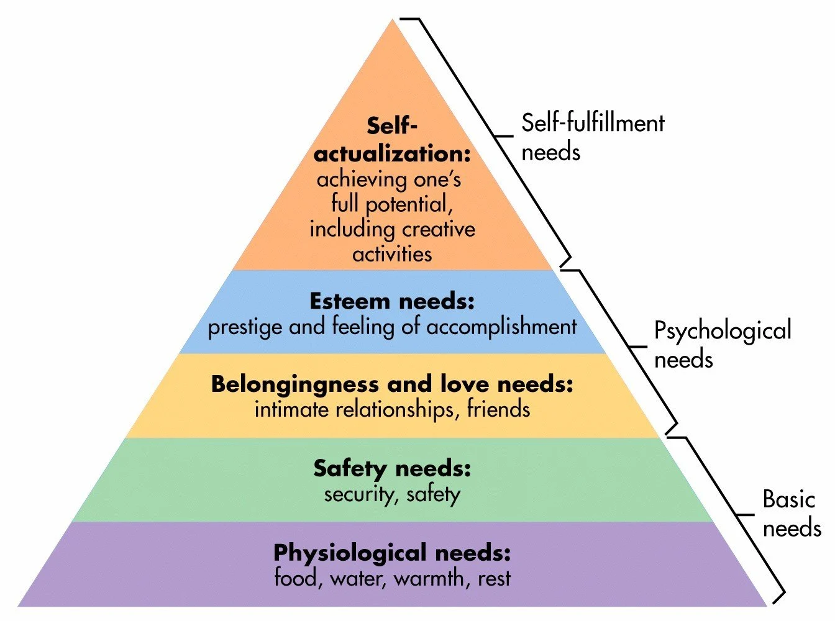
What does this mean for what you tell your children?
The world that’s coming is one that prizes emotional intelligence, empathy, and embodied skills such as one-on-one conversation and public speaking. Find ways to cultivate these in your child. Drama and the performing arts are wonderful ways to do this. So is a debate club. So are music lessons, because they require deep listening and attentiveness to another person.
One thing I’m sure of: in an age of superintelligent machines, the ability to speak human — to be a compelling, persuasive, charismatic storyteller — is gold dust. Encourage your child to overcome any fear and seize opportunities to stand in front of others and speak. Encourage them to become persuasive, engaging writers. If you can put text online that others find compelling, then you will be able to carve out a role for yourself in the age of AGI. If you can stand in front of others and persuade them — sell to them — then there will be a role for you.
There’s a tendency among some to dismiss the kinds of things I’m talking about here as soft skills.
I can’t stress this enough: AIs are conquering the so-called ‘hard’ stuff. For most, apart from a tiny cognitive elite who work with AI at the intellectual frontier, opportunities and career paths will increasingly be found around the human stuff: feelings, experiences, fandom, and more.
In truth, this shift will only be the acceleration of a process that has long been in train. Teenagers who want to be YouTube influencers instinctively understand that an increasing portion of the economy is becoming about connection to a fellow human being who you believe gets you.
So I want to talk, in a moment, more about that. But first, a quick interlude.
4. Look again at the humanities
This one can be short. But it can help guide decision-making around academics and lifelong learning.
The humanities — literature, history, philosophy and more — have had a tough couple of decades. For various reasons, their reputation is at a low.
But I think these disciplines are due to make something of a comeback.
As per my thesis above, in an AGI world an increasing amount of knowledge work will become about the things only we humans can do. And part of that will be around the making of value judgements. How should our company treat the environment? What does a good healthcare industry look like? How should we order our society?
Insofar as there is still a human cognitive elite in the world that is coming, much of its work will be around making these kinds of judgments. People who are trained in thinking deeply about ethics, conflicting values, and unstructured human problems — and who can call on the history of thought around all that — will be of value.
What’s more, people who are steeped in our shared history and culture will be among those most able to coax the best outputs from AI models.
So encourage your child to read widely in the humanities. Fiction, philosophy, the history of art: it is all valuable. The AIs we’re building are mirrors of ourselves and our shared past and culture. Those who are steeped in that culture will be able to dive deep into the worlds contained inside these AI models; those who are not can only skim the surface.
If your child is going to study a STEM subject, great! But they can still supercharge their value by immersing themselves in these subjects too.
And for those wondering: in an AGI world, is it still worth it for my child to go to college?
My view: yes, absolutely. The life skills and confidence they’ll gain, and the social capital they’ll gather, are just as important as any subject-specific content they’ll learn. That has probably always been the case — but in an AGI world life skills, confidence, and social capital are even more important.
5. Encourage your child to think audience and community
I’ve established the idea that ever-more of the economy will shift towards human connection: counsel, advice, empathy, entertainment, fandom.
How will that look in practice?
For many, it will mean building an audience or community who connects with them and loves their take on a particular subject or issue. Essentially, about building a community of fans.
I know what you’re thinking: but my child can’t expect to be Taylor Swift, or Mr Beast! They can’t earn a living from fans! That’s not realistic!
I get it. But you’re stuck in an old one-to-many media model.
No, our children (probably) won’t be global pop sensations or online influencers with hundreds of millions of followers. But there will be a billion tiny niches — and each one will have its Mr Beast. Rising numbers of people will earn a decent living serving entertainment, empathy, and human connection to their own tiny community.
The child that once would have become a successful lawyer or consultant is now just as likely to end up a creator and community builder around say, personal finances, or retro Lego sets, or wild swimming — the list is endless. Those micro-communities will be more about the sharing of experiences, and empathy, and feelings, than they are about the transfer of information.
AI will play the matchmaker, helping consumers find the communities and creators that they want to connect with.
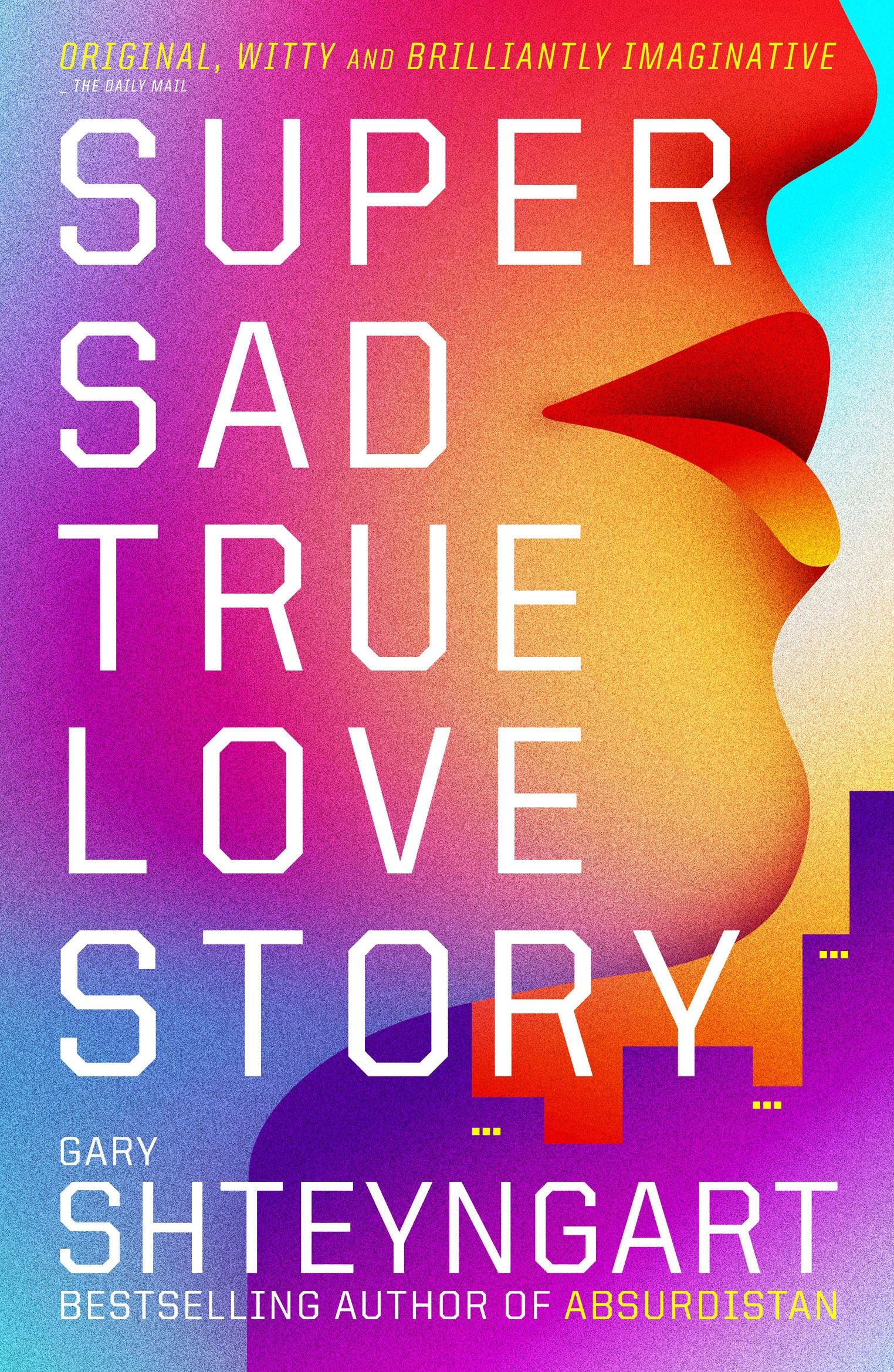
The brilliant novel Super-Sad True Love Story by Gary Shteyngart, captures this coming world. In that novel, people are constantly streaming their lives to one another and accepting micropayments in exchange for the value, empathy, and good vibes they provide. I really believe a large part of the coming economy looks like that.
This mindset will be valuable even to those knowledge workers who are employed by larger organisations. Inside those organisations, there will be far less call for workers who are simply delivering rote knowledge work; the AIs will do that. Instead, all the value will shift up the chain to those who can cultivate communities, reach out to new customers and clients, and persuade.
Think about a major global consultancy such as McKinsey. Across the next ten years, much of the PowerPoint-jockey work done by the lowly associates will be automated. The human roles left inside the organisation will go to those who can build community, who are charismatic, engaging storytellers and persuaders. They will be the human face to a whole lot of AI-delivered analysis.
So my advice?
Encourage your child to have a creator mindset when it comes to the internet. Let them safely experiment with creating content — articles, audio and podcasts, and video — and putting it online. Talk to them about the power of building a small community that values your unique perspective on the world.
My boys create short videos and upload them to YouTube — skits, puppet shows, product reviews. The subject matter, and even the quality, aren’t really important. No one watches them anyway (apart from us).
The point is that I’m endlessly telling them: don’t be only an internet consumer, be an internet creator, too.
And when your child creates content for the internet, it allows you to ram home another powerful lesson. That is: remember, anyone can put ANYTHING online. A lot of it will soon be AI generated. Watch with a critical eye.
6. Let your child lean into their weirdness
Again, I’ll keep this one short. But it’s so important.
As per the above, many ways to deliver value in an AGI world will revolve around finding a tiny niche and cultivating a community or audience of fellow travellers who love your unique take.
How do you find that niche? How do you engage those fellow travellers? How do you cultivate a unique take? The answer in all three cases: lean into your weirdness. In other words, into what makes you uniquely you.
In the AGI world that’s coming, outsize returns will flow to those who are willing to be odd, to stand out, to be weird. And who are able to communicate that weirdness in compelling, persuasive ways.
This is the opposite of the approach we’ve taken to children across the last 200 years. Our education system is still built around the factory line; a form of work in which humans are interchangeable parts, each performing the same task over and over. The experience of school irons out difference and standardises our children; meanwhile, we instil in them the idea that it is better to be silent than to be wrong.
In an AGI world, the virtues that this approach breeds — mainly, the ability diligently to perform a standardised intellectual task over and again — won’t be of much use. AIs will do that work. People will look to people for compelling points of view.
Your child’s weirdness is in there somewhere. Find ways to help them let it out.
Start by asking some age-appropriate form of this question: what is one thing you believe to be true that very few others do? Why do you believe this? Why do you think others don’t?
7. We must cultivate our garden
And so we come to my final principle.
I’ve gone on longer than I expected. And yet I feel I’ve hardly scratched the surface of what is coming, and how we should prepare ourselves and our children for it.
As it sounds, the Economic Singularity will be a bewildering time to be alive.
The nature of economic activity is going to change — perhaps beyond all recognition. And there’s no getting around it: this could mean significant social upheaval, and perhaps a fullscale breaking and remaking of the socio-economic conditions we live under.
During the period of transition there will be vast disruption when it comes to labour and working lives. Many will find it hard to navigate a path through all this.
AGI is likely to mean vast returns to the owners of capital. As corporations and states come to rely less on the labour of humans, the social bargaining power and relevance of ordinary people in the face of these institutions will diminish. This threatens to upend our democracies.
You get the picture. It’s going to get weird.
Perhaps the powers-that-be will choose to distribute the rewards of AGI via some form of universal basic income. Perhaps we’ll build a world of shared abundance. Perhaps we’ll choose to double-down on democratic forms of political organisation.
But perhaps not. And even if so it is possible — I would say probable — that some great convulsion is ahead before we get to the promised land.
As I said at the start, emotional resilience will be key. There will be so much about what is coming that none of us can control, or even understand.
In that environment, we need to teach our children to Cultivate Their Own Garden. This iconic closing sentiment from Voltaire’s Candide is one of my favourite lines in all literature, and it contains so much wisdom for us today.

The message is this: the world is chaotic, unstable, and often brutal. Amid all that, all you can do is tend to the parts of this world that you can have some control over. That means your deepest connection with close family and friends. And the tiny part of this planet that you spend your days in.
Instil in your children the idea that the fabric of their lives won’t be woven via their role in the ‘economy’, but via their deep relationships with those closest to them. Build around them an atmosphere of mutual support and understanding. Overcome any petty family differences if you can.
I know, all of this is easy to say and hard to do. But in the world that is coming, you are going to need each other. The institutions and support systems that have been in place in the Global North in the post-WWII era are going, at the very least, to go through a period of severe stress. You need your family to be an enclave of support and safety amid all that.
A quest to have a great impact on the world can be a wonderful thing. But teach your children, too, that in a world of overwhelming complexity, small is beautiful. That comes via connection to a meaningful micro-community. Connection with nature. A sense of self that transcends their life as a professional.
This is the foundation on which everything else can be built.
The World is Yours
So there we have it.
I started this piece by saying that I’m fundamentally optimistic about what’s coming. That might seem strange, given the scale of change I think is ahead and the grave challenges I just talked about in my final principle.
But my optimism, as I hope I’ve made clear, is grounded in a simple truth. We humans care, in all sorts of ways, about other humans.
That truth will form the basis of the economy — if that’s still the right word for it — that is ahead. It can, and should, form the basis of the routes our children try to carve out for themselves, and the ways they try to live their lives.
The comic actor Jim Carrey might seem an unlikely source of wisdom in a piece such as this, but a while back he said something that strikes me as profoundly true. He said that a life spent making people laugh has taught him one lesson: the impact you have on others is the most powerful currency there is.
In the end I think that this is the foundational, immutable currency: impact on others. All other currencies are only a proxy for this. It’s the currency that is certain to survive, even beyond the event horizon of the Economic Singularity.
So embed deeply in your child an understanding that if they proceed with that truth in mind, they can build a life full of opportunity, meaning, and joy. As Raoul likes to say:
We’re in this together. In the end, we all realise that the experiences we shared were the point all along; the journey we took was the destination. Deep connection to each other, and to the world we find ourselves in, is at the heart of everything.
I believe the changes that are coming — and most of all an AGI world — will in the end do even more than fuel head-spinning economic change. They’ll lead to something akin to a spiritual transformation among us. One that leads us back to these core truths.
But now I’m drifting to a different domain altogether. If you’re interested in coming on that journey with me, then check out my other essay in this month’s edition: Life, the Universe, and Everything.
Prepare for what is coming with The Exponentialist. Subscribers get monthly deep dive essays, live fireside chats with me and Raoul, expert guest video interviews, an investment portfolio, and more.
So much here that mirrors my own thinking. We need to catch up!
Absolutely fascinating, nice to see it laid out so thoughtfully, hold on to your hats! it is eventually going to be a much happier and far more human life ahead for our children, this stultified grey pablum currently being offered to so many will hopefully be washed away, thank you for that extremely interesting…