
Welcome to this update from New World Same Humans, a newsletter on trends, technology, and society by David Mattin.
If you’re reading this and haven’t yet subscribed, join 30,000+ curious souls on a journey to build a better future 🚀🔮
A quote has been reverberating through my head recently.
‘This is how a species prepares to depart for the stars. You don’t depart for the stars under calm and orderly conditions. It’s a fire in a madhouse.’
That’s Terence McKenna, the counter-culture philosopher and mystic who was active from the 1970s until his death in 2000 at age 53. McKenna had a great interest in philosophy, nature, and psychedelics. But when he spoke this quote in a wide-ranging interview in 1998, he was in a phase of his life during which he was reaching for new ways to understand the technological liftoff that seemed to be firing up around him.
Of course, that liftoff is now somewhat further along. This quote is almost 30 years old, but its power has only become more visceral.
Via the AI revolution we’re living through, we are all bearing witness to a kind of progressive enweirdening. McKenna’s fire is raging harder than ever. Every week brings a new frontier model, a benchmark shattered, or yet another trillion-dollar commitment to AI infrastructure.
Amid all this, we want to make sense of what’s happening. Our need for explanations — for some kind of stable ground — is becoming acute. And there is no shortage of media on hand to help us. The very AI revolution we’re trying to describe is also helping us to pump out every more analysis and explanation on what AI can do now, what it will be able to do soon, and what all this means for the economy and the future of work.
We know that the capability of frontier models continues to accelerate. Last week we learned — via what seems to be a leaked draft of a blog post — that Anthropic will soon release Mythos, a massive new model that, so runs the post, represents another giant leap forward in capability.
But despite their growing power, there’s something the machines still can’t help us with. In fact, they’ll never be able to
A machine can help analyse the transformation for us. But no machine can ever know how it feels to be a person living through this fire in a madhouse. Only another human can understand this, and can commune with us on the basis of that shared understanding.
In times like these, what we need most is each other. That is, we need other people who know how all this feels. Who are living through the same mixture of disorientation, exhilaration, and terror.
This taps into a deep truth. It is this: authentic connection to other people is not an incidental feature of our existence. Rather, it is fundamental. It makes us who, and what, we are. Via other humans, whose mode of being is human like ours, we construct a shared view of the world that is the foundation for the very possibility of meaning. Human fellowship is the ground we stand on.
And that leads to a realisation that, for me, is running deep.
As the machines grow more capable and the fire burns hotter, we’re going to need — and to seek out — human connection with a new urgency. We’ll build communities of all kinds to help us get through this period of growing weirdness. We’ll gather in small groups — around dinner tables, in nature, in corners of the internet where the conversation is real — because the alternative is to face the madhouse alone. And that is intolerable.
The technologies are going to be astonishing. But in the end, they will lead us back to a powerful truth.
That is: that our connection to the given world, and to one another, is sacred. To get through what is coming with intelligent machines, we need to strengthen those bonds. We need to build a Republic of Being Together.
I’ve got some plans on that front. Plans, that is, to build our own Republic of Being Together here at New World Same Humans. I’ll say more in the coming weeks.
In the meantime, be well,
David.
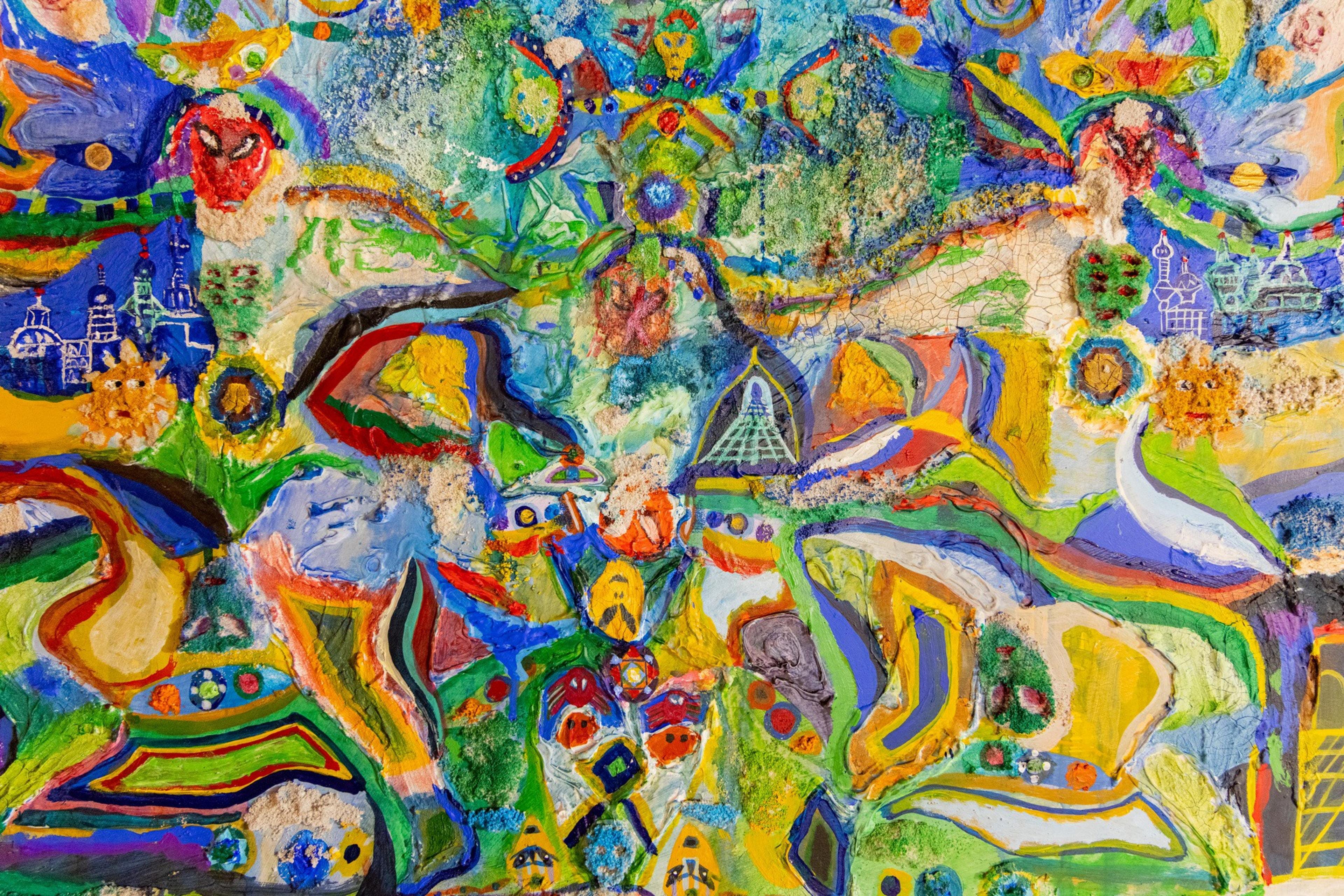
This was #24 in the series Postcards from the New World, from NWSH. The title artwork is Everyone Had Tarantism by Joe Roberts
Terence McKenna wasn’t just describing chaos—he was pointing at a deeper condition: the moment when a system begins to outgrow its own capacity to describe itself.
The “fire in a madhouse” is not merely acceleration or disorder. It’s the sensation of reality exceeding the frameworks that once held it. Language starts to thin. Models—intellectual, cultural, even perceptual—begin to flicker at the edges. What we’re left with is a kind of collective reaching: a grasping toward something that cannot yet be fully grasped.
This is the threshold McKenna was circling—the encounter with the ungraspable.
And in that sense, AI is not just another technology within the fire. It is a strange new organ of that reaching. Not because it resolves the ungraspable, but because it extends the gesture itself. It allows us to probe, iterate, reflect, and refract thought at a scale and speed that begins to approximate the complexity we’re confronting.
But there’s a paradox here.
The more AI helps us map the contours of this emerging reality, the more it reveals that the core of it may remain irreducible—something that cannot be compressed into models, tokens, or outputs. Not because of a limitation of intelligence, but because the “ungraspable” is not a problem to be solved. It is a horizon condition of being.
So perhaps this moment isn’t about finally understanding everything.
It’s about developing a new kind of cognition—one that can remain coherent in proximity to what exceeds it.
AI may help us build that capacity.
Not by giving us answers, but by accompanying us deeper into the question.