
Welcome to this update from New World Same Humans, a newsletter on trends, technology, and society by David Mattin.
If you’re reading this and haven’t yet subscribed, join 30,000+ curious souls on a journey to build a better future 🚀🔮
In the 20th-century, we realised that nature was in trouble.
We didn’t come to that realisation suddenly. It happened slowly, then all at once. People noticed that the local river was dying. That birds and fish were vanishing. That the air in their city was becoming unbreathable. For a long time, most did nothing. This was the price of progress.
But eventually, a critical mass of people looked at what was being lost and said: no. These people realised that we were about to lose central features of the world that was given to us, and that once lost those features would never come back.
And so the conservation movement was born. It became one of the defining moral commitments of the last few decades. We built institutions around it. We changed laws. We shifted the way our cultures thought about our relationship to the natural world.
I think we’re about to enact a similar process. Only this time, the precious entity that needs conserving isn’t nature. It’s us.
We humans are under threat from emerging technologies of vast and transformative power. I don’t mean threatened in the way we keep hearing about these days; that is, in an existential way. I’m not one of those who believes that AI will soon turn us all into paperclips. I mean something more nuanced than that. My contention is this: the technologies emerging now pose a deep challenge to everyday human ways of living and being, and to the the organically-evolved norms and institutions that have long shaped our lives.
At the heart of this threat is the rise of superintelligent machines.
AI is, for example, about to reshape the job in a violent way. Not in the way previous technologies reshaped it — by automating physical tasks — but by colonising cognitive and creative territory we assumed was ours. It is reshaping the media we consume; already we are drowning in algorithmically-served content that targets our impulses with unhuman precision. It is beginning to reshape our most intimate relationships. The AI companion — endlessly patient, always available — is arriving. It will be the most potent form of synthetic intimacy ever created. There is someone reading this whose child will tell them, ten years from now: I’m dating an AI, and I want you to be happy for us.
I could go on. And these are just the early tremors. The end game here is far deeper. In the end, these technologies pose a threat even to the human person itself, and to the uniquely human way of seeing the world. A growing faction — often found in Silicon Valley and adjacent communities — now seriously propose that we should soon merge with our machines, and become something else. Something, as they see it, more.
These people want to push us beyond the limits of biology, and the constraints of the body. Beyond, in the end, the condition of being a human at all.
That position is becoming increasingly influential. But it won’t be left unchallenged. An all-consuming battle is coming between those who seek technology-fuelled transcendence, and those who utterly reject that vision of our shared future. Those who want to remain resolutely human. Who believe that mortality, embodiment, and the whole package that is our messy, organic existence is not a limitation to be transcended but something precious that must be protected. These people will scream back: it is our limits that make us what we are.
Those people don’t yet know they are a movement. But soon enough, that awareness will emerge. Because they will come to recognise that they share a common cause: it is conservation. The conservation of the human way of living and seeing the world amid the rise of new, machinic realities.
We built a conservation movement around the natural world. We did it because we saw that something irreplaceable was under threat from the white-hot fire that is technological modernity, a force that seems to melt everything in its path.
In so many ways, that was just a trial run. What we’ll fight for next is the conservation of the human. It’s now clear that the first conservation movement was not an overwhelming success. Let’s see how we do with this one.
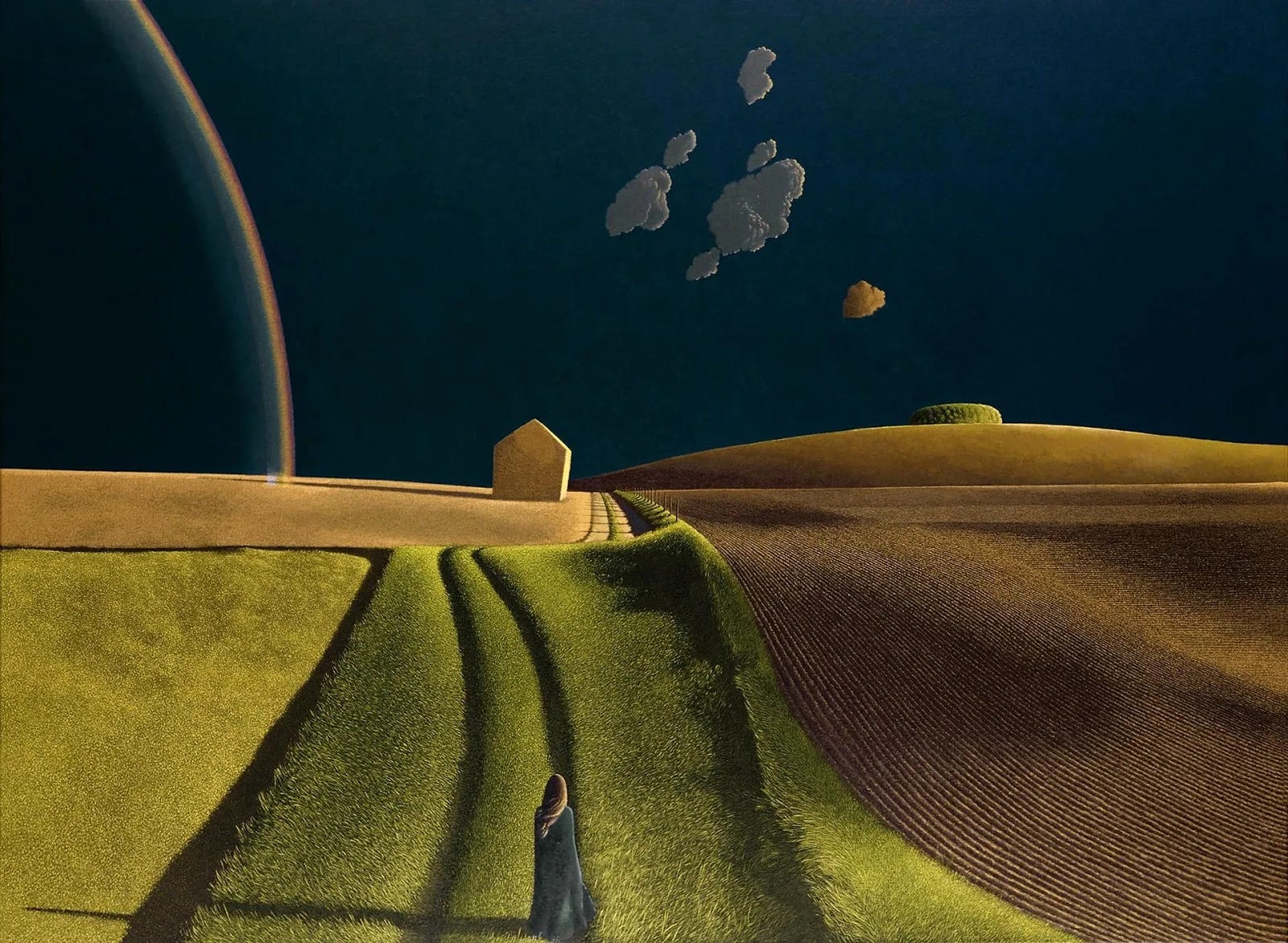
This was #20 in the series Postcards from the New World, from NWSH. The title artwork is She Did Not Turn (1974) by the British painter David Inshaw.
I was worried reading this as I went until finally at the end you recognized that the environmental movement was not successful. It is looking to me like this next battle is heavily favoring the combined human/machine group already. They will have most of the money and will be far smarter (by the combining). Although they appear to be well outnumbered (like the non-environmentalists far outnumber the environmentalists), their superior intelligence and resources should steamroll the humans-only group. Personally, I don't have a side. But, I am 100%+ in favor of letting those that want to become part machine do it without interference. Regardless, you are right David - this is the great battle from here on. Will be interesting to see what the next great battle will be after this one. As the story goes, we may not know exactly what all weapons will be used in World War III, but do know what will be used in World War IV.
The “New Amish”.