
Welcome to this update from New World Same Humans, a newsletter on trends, technology, and society by David Mattin.
If you’re reading this and haven’t yet subscribed, join 30,000+ curious souls on a journey to build a better future 🚀🔮
What can technology do for us? For decades now, one of the most prominent answers has been: it can deliver us into more free time. As we all know, Keynes imagined a 15-hour work week. The futurists of the 1960s pictured a Jetsons-style civilisation of leisure.
I think about this promise a lot at the moment. I spend most of my work time researching, thinking, and writing. And if you do this kind of work or many adjacent kinds of knowledge work — and I know that plenty of you do — then you’ve just been handed an absurdly powerful productivity tool.
I don’t know about you, but I can report from my own personal front line: the leisured life has not arrived. In fact, quite the opposite.
I use LLMs every day, and across the last few months — since the launch of Opus 4.5 — the outputs have astonished me. I don’t want AI to write my work, of course. But I can research a topic, spar with a great thinking partner, and outline a complex argument at a pace that would have seemed impossible even two years ago. I should be finishing by lunchtime and spending my afternoons playing tennis, right?
Instead, I’m working harder than ever.
So what’s going on? The problem, paradoxically, is that the models now work so well. When I wake up and realise I can now produce a research note that would once have taken a week, I don’t think: wonderful, I’ll take the rest of the week off. I think: what else can I do? I could respond to that essay, write that thread, build that dashboard, explore that idea. The sheer expansion of what’s possible creates a kind of obligation to pursue it.
This is the strange secret of the productivity revolution. I’m starting to suspect that the tools won’t liberate us from work; instead, and in many cases, they’ll become a vector for lots more work, because they’ll reveal how much output was previously left on the table. Every hour of effort now yields so much more that it feels wasteful not to invest it. The opportunity cost of rest has gone vertical.
I feel this acutely, and I know I’m not alone. Friends in technology, media, and finance are all saying the same. There is a sense of being supercharged, exhilarated even; and also, somehow, more pressed for time than ever before.
I know that this is a limited sample. And that it’s all drawn from people doing a certain kind of cognitive work. Still, there’s something deep here, I think. Something about the psychology of abundance that we haven’t reckoned with. We assumed that when certain constraints fell away — when it became possible to produce more knowledge work in a day, or a week — we’d relax. But I think it turns out that, often, humans don’t respond to the lifting of constraints by doing less. Instead, we push back the horizon of our ambitions.
So far, for me at least, the arrival of Intelligence Age isn’t a story about having more time. It’s a story about having more capability and becoming obsessed with using it. In the end, this feels a continuation of an ongoing trend. The internet changed the way we work, but no one thinks it helped us to work less hard. Phones certainly didn’t.
Perhaps this is what it means to be a creature wired by evolution to strive, now equipped with weird new superpowers. The technologies change; the restlessness remains. New world, same humans.
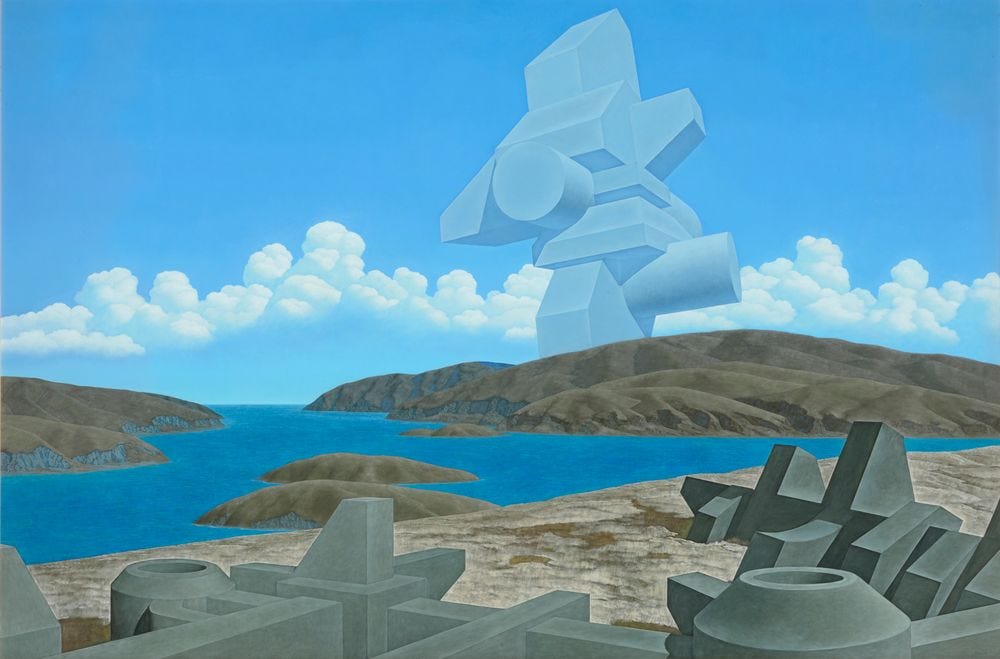
This was #21 in the series Postcards from the New World, from NWSH. The title artwork is Mean Time Exposure by the New Zealand artist Brent Wong.
One of the projects that’s been keeping me busy? It’s Full Moon, the strategy, trends, and futures thinking service I launched recently with Mark Curtis.
Mark, the former Global Head of Thought Leadership at Accenture, just published a brilliant essay on the human quest for relevance and what it means for brands and businesses. If you’re trying to craft products, services, campaigns and more that people love, you need to read this:
Watch out for some exciting announcements on Full Moon!
Some 30 years ago research showed that people who owned a clothes dryer spent more time washing than people who didn’t - because it was easier to do a quick laundry. So they did it more often. Same principle.
Yes, for now. Let's see in a decade (or less).