
Welcome to this update from New World Same Humans, a newsletter on trends, technology, and society by David Mattin.
If you’re reading this and haven’t yet subscribed, join 30,000+ curious souls on a journey to build a better future 🚀🔮
Last week Sam Altman stood before a room of infrastructure investors and described a future in which intelligence is a utility. People will buy it on a meter, he said, like electricity or water. He even borrowed an old phrase from the nuclear age: intelligence, he said, will one day be too cheap to meter.
We’ve come to expect clever rhetoric from Altman, and this was another example. He was speaking at the BlackRock Infrastructure Summit, and telling the room exactly what it wanted to hear: that intelligence is becoming infrastructure, and that infrastructure is a thing you can build, own, and bill for.
His statement taps into a framework I’ve been developing for a few years now. I call it AI as electricity, AI as magic. The core idea is that machine intelligence will manifest in two fundamentally different ways. On one side, AI becomes something akin to a new form of energy: a commodity fuel that powers everything happening in the future taking shape around us. On the other, AI becomes a kind of magic: tools, services, and experiences that are so useful, so context-aware, and so adapted to us that they feel like they work by enchantment.
Altman’s vision of intelligence on the meter maps neatly onto the electricity side. And there’s something real here. Intelligence really is becoming an abundant resource that flows through everything. It will power the agents doing our knowledge work, the robots stacking our shelves, the cars driving on our streets. It will seep into a billion connected objects.
But there’s a problem for OpenAI. One that becomes easier to see via the AI as electricity, AI as magic framework. The electricity business is a commodity business. There are now a host of powerful AI models — Meta’s Llama, DeepSeek, Anthropic’s Claude, and more — and they are all good enough to do most of what anyone needs. If you’re simply selling access to intelligence, you’re locked in a race to the bottom on price. That’s a brutal place to be.
The real winners of the intelligence revolution will be those who deliver AI magic. That means leveraging intelligence to build tools that serve people in powerful ways. Think apps that know your context, anticipate your needs, and act on your behalf. Or an Everything Companion that acts as an everyday assistant, counsellor, and philosopher to you. Magic requires not just a model, but a deep relationship with users — an understanding of their contexts, behaviours, and preferences — and the ability to distribute at massive scale.
OpenAI knows all this. The $6.5 billion acquisition of Jony Ive’s io is a bet on a magical kind of AI experience via hardware and product design. See, also, last month’s acqui-hire of Peter Steinberger, creator of OpenClaw, the viral AI agent that does things on your behalf. It’s another attempt to vault from the electricity side of the ledger to the magic side.
But here’s the thing. OpenAI is competing against Alphabet, which has unmatched distribution via Search, Android, Gmail, Maps, and YouTube, and near-unlimited resources. It’s competing against Apple, which owns the device in your pocket. These companies already have deep, daily relationships with billions of humans.
When you understand the quest for AI magic that the world’s leading technology companies are engaged in now, you see that OpenAI, for all its fame, faces a challenging future. I certainly wouldn’t write Altman off; he’s proven himself canny, determined, and ruthless. His challenge, now, is to turn electricity into magic.
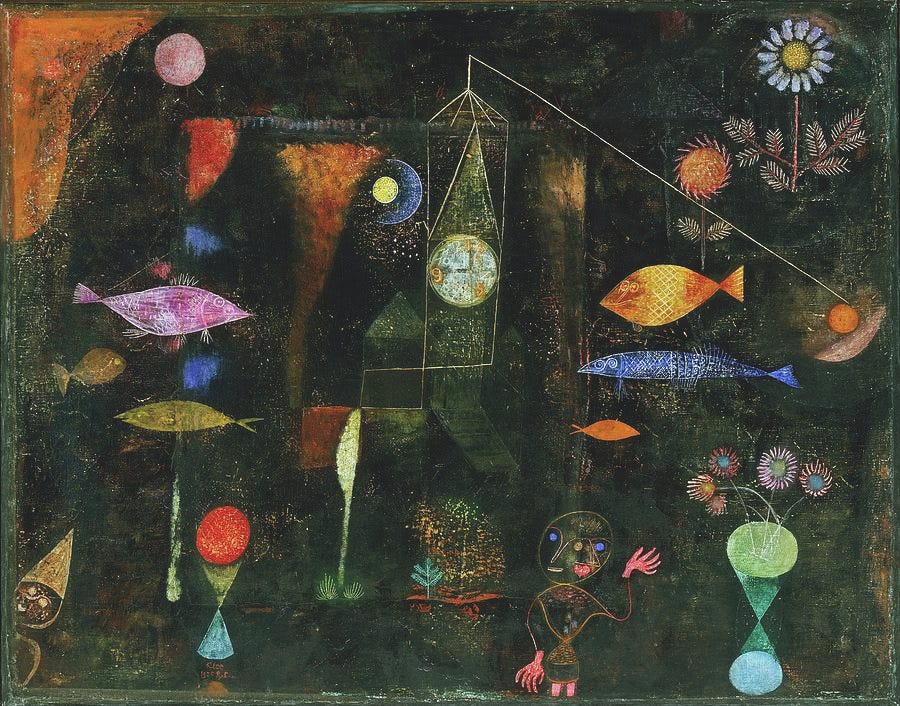
This was #22 in the series Postcards from the New World, from NWSH. The title artwork is Magic Fish (1925) by the Swiss-German painter Paul Klee.
Props for adding Klee's Fish Magic to the post!
I'm not as optimistic as you here. The "intelligence as electricity" is a good framing in the "AI as normal technology" sense. However, "intelligence" is a word that stands to replace Tesla's "autopilot" as a more robust cognitive analogy than deserved.
That last mile matters, and it can mean the difference between life or death if not respected. Yes, we can take all the data on the Internet and run a regression towards the mean as a kind of wisdom of the crowds. But things like hallucinations aren't bugs to be squashed as much as they are core to the inner workings of this generation of AI technology.
Personally, I don't see the path to where you expect yet until, as Altman suggested days ago, a new paradigm shift is necessary to reach these goals. Hence why all the classic researchers have fled for other pastures. Not to mention that humans aren't binary, and modeling quantum humans in binary is riddled with errors. (A nod here to my belief that quantum computers offer a way better route than brute-force binary ones.)
As for the second "AI as magic" premise, the magic won't last. The best popular encapsulation of this social phenomenon was explained 15 years ago by comedian Louis C.K. as "Everything is amazing but nobody is happy": https://www.youtube.com/watch?v=PdFB7q89_3U
Which I can summarize as, "How quickly the world owes him something he knew existed only 10 seconds ago."